

Climate Change Advisors Ghana (CCAG) has made a groundbreaking donation of intricately designed, locally crafted wire mesh recycling bins to the University of Cape Coast (UCC) and Cape Coast Technical University (CCTU).
The beautifully crafted metal bins will be strategically positioned across campuses, making it easier for students and faculty to collect, dump and recycle plastic waste.
The ambitious project goes beyond the universities, with plans to expand to all tertiary and pre-tertiary institutions, communities, public places and various institutions across the country.
At the heart of this initiative lies a profound goal to instill a culture of environmental sustainability, aligned with the Sustainable Development Goals 6, 11 and 13 to reduce plastic pollution, promote waste segregation and recycling, protect the environment and inspire behavioral change among students and the broader community.
The impact of this project will be far-reaching, mitigating the financial and environmental burdens associated with plastic waste generation and pollution.
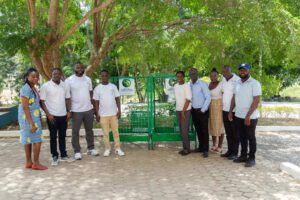
Dr Samuel Ayeh Ofori, Director of Research and Programmes at CCAG and a Senior Lecturer at, the University of Cape Coast (UCC) and Mr Peter Doh, Co-founder of CCAG presented the items to the two institutions. They stated that the intervention formed part of their “Zero Plastic Waste Initiative” which is focused on combating plastic pollution and fostering environmental sustainability through effective waste management. They said CCAG will collaborate with local authorities, private waste management firms and educational institutions and implement a tracking system to assess the effectiveness of the recycling initiative and ensure that the bins were utilised efficiently.
Accordingly, CCAG will engage policymakers to advocate for improved policies and regulations that support plastic waste recycling and sustainable waste management practices in Ghana.
“The project is a critical ste
p towards achieving a cleaner and greener Ghana”. Through strategic partnerships and advocacy, CCAG aims to make a lasting impact on plastic waste management and environmental sustainability in Ghana.“By fostering a culture of recycling and responsible waste disposal, this initiative will contribute to a healthier society and a more resilient environment for future generations,” they stated.
 p towards achieving a cleaner and greener Ghana”. Through strategic partnerships and advocacy, CCAG aims to make a lasting impact on plastic waste management and environmental sustainability in Ghana.“By fostering a culture of recycling and responsible waste disposal, this initiative will contribute to a healthier society and a more resilient environment for future generations,” they stated.
Receiving the items, Professor Denis Aheto, the Pro Vice-Chancellor of UCC and Mr Gideon Enoch Abbeyyuaye, the Registrar of UCC were grateful for the gesture and urged CCAG to intensify policy reforms on the use of plastics. They highlighted examples from Rwanda and Kenya on banned plastics due to socioeconomic and environmental impacts.
Similarly, at Cape Coast Technical University (CCTU), Dr Stephen Agyafi Mensah, Acting Director, Works and Physical Development and Dr Nana Esi Baduwa Taylor, Patron, Green Club of CCTU said the institution had been at the forefront of green initiatives in Ghana.
Receiving the items at CCTU, Dr Stephen Agyafi Mensah, Acting Director, Works and Physical Development and Dr. Nana Esi Baduwa Taylor, Patron of Green Club of CCTU, commended the CCAG’s leadership in green initiatives over the years, showcasing their dedication to environmental sustainability through various projects and programmes. They mentioned that CCTU is committed to becoming a leader in green and clean energy technologies in Ghana.
Climate Change Advisors Ghana (CCAG) is a not-for-profit organization that delivers advocacy, research, policy analysis, and capacity development in climate change adaptation, circular economy, renewable energy, climate-smart agriculture, and environmental sustainability.
Source: Ghana News Agency (GNA)
By Isaac Arkoh, GNA
Dated: April 11, 2025.